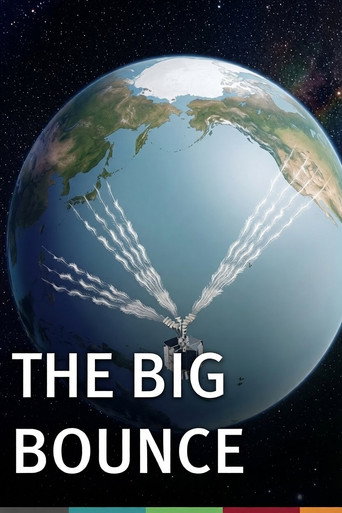
The Big Bounce (1960)
1960 · Ephemeral film · 14 min · dir. Jerry Fairbanks
- Documentary
Synopsis
The story of the Echo communications satellite program, developed by Bell Laboratories, that eventually resulted in telephone calls being able to be made through satellites.
Synopsis from TMDb
Details
- Director
- Jerry Fairbanks
- Writer
- Leo S. Rosencrans
- Composer
- Gene Kauer
- Studio
- Jerry Fairbanks Productions
- Released
- 1960-03-11
- Running time
- 14 minutes
Cast & crew
- Jerry Fairbanks Director
 Larry Thor
Reviews on the Internet Archive
★★★★★ · Quite an astounding little picture · Spuzz · 2003-01-18
The Big Bounce outlines America's first trial run at basically satellite conversations. We follow the trials of the Bell Corperation's first satellite project. Instead of being boring and scientific mumbo-jumbo like, the film packs a lot of suspense and drama into the film, the narration packs quite a punch and keeps us enthralled about whether the experiment will work or not. Mind you, the acting isn't the greatest from the scientists, but who cares? This is a taut little thriller, and deserves to be watched. Great soundtrack too!
★★★★★ · presenting a view to 'new' technology · bullymuk · 2004-03-29
This film show in a wonderful way how fast 'sience fiction' could become true. It shows the first attempt to establish a phone call via satellite. Enjoyed showing it to students to look into the past of mass communication.
★★★★★ · Keep an eye out · 2muchtv · 2004-05-03
For scenes from this, and many of Fairbanks' other government shorts when you watch one of his Sci-Fi films, like "The Bamboo Saucer." An early partner with Jay Ward (they worked on Crusader Rabbit until Fairbanks went bankrupt and NBC took Ward and his properties as part of the foreclosure) Fairbanks (Jerry) Productions limped along floating between shorts and B movies.
★★★★★ · First Step to the Future · Pleonic · 2007-09-09
A fascinating film depicting the beginning of something we now take for granted: Satellite Communications. This film shows that the entire system, including geosynchronous satellites, was already planned out in the early 60's, but as the narrator says, that was for the far distant future. Now we live in that distant future, and Echo was the first step. An enormous mylar balloon in orbit, Echo enabled scientists to bounce radio waves off its silvery surface. According to the book Angle of Attack: Harrison Storms and the Race to the Moon, it also provided reference points used by the military…
★★★ · The Big Bounce · Christine Hennig · 2003-07-02
This film, made by Bell Labs, documents the first satellite telephone transmissions, using a satellite balloon named Echo. Considering how ubiquitous satellite communications are today, this is rather quaint to watch. It's pretty straightforward and well-made, with some mstable moments. President Eisenhower's recorded message, back with "America the Beautiful" is schmaltzy as all get-out. Overall the film is a mildly interesting bit of history. Ratings: Camp/Humor Value: ***. Weirdness: **. Historical Interest: ****. Overall Rating: ***.
★★★ · The Future Came Fast · donwert · 2010-02-02
This Bell Labs documentary of the Echo Project is interesting. The narrator says that geosynchronous satellite communications is in the "far distant future", yet only 4 years later, the Syncom III satellite was used to broadcast the opening ceremonies of the Tokyo Olympic Games live to the U.S. I don't know how much money was spent on the Echo project, but it's a little difficult to understand why the project was undertaken in the first place since it was perfectly obvious the technology had no practical value and all-electronic geosynchronous satellites were already being developed. I can…
More like this
 Highlights (1965)
 Plane Talk (1965)
 Century 21 Calling (1964)
 The Nation at Your Fingertips (1951)
 Television Commercials: Telephone (1970)
 The Town and the Telephone (1950)
 Telephone and Telegraph (1946)
 Communication (1928)
 How to Use the Dial Phone (1927)
- Communication: A Film Lesson in General Science / Development of Communication (1927)