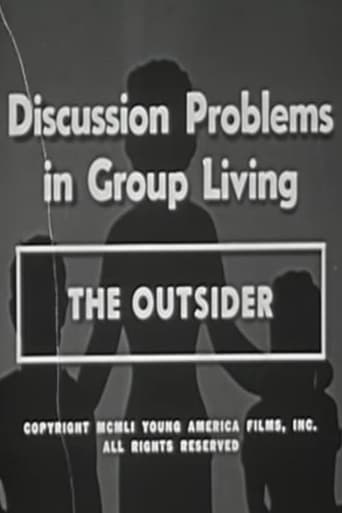
The Outsider (1951)
1951 · Ephemeral film · 12 min · dir. Arthur H. Wolf
- Drama
- Family
Synopsis
Susan, a pretty high school student, has everything going for her—except popularity. She can't figure out why she is so "out of step" with the rest of the crowd. She finally comes to realize that her habit of "hanging back" and "not trying to fit in" is making her unpopular. She vows to change her ways and go along with the crowd, which means that people will like her.
Synopsis from OMDb
Details
- Director
- Arthur H. Wolf
- Writer
- Margaret Travis
- Studio
- Centron Corporation
- Released
- 1951-06-14
- Running time
- 12 minutes
- Language
- English
- Collection
- Prelinger Archives
Subjects on the Internet Archive
- Social guidance
- Psychology
- Gender roles
Cast & crew
- Arthur H. Wolf Director
- Arden Booth
 Vera Stough
Reviews on the Internet Archive
★★★★ · Inadequate · jenniferger · 2008-08-28
Well, once again, the film means well, but it fails to recognize or even consider that school-yard popularity is not always based on something meaningful. Kids ostracize each other over clothes, financial status, race, how their parents look and dress, and all kinds of other things and some kids will NEVER be accepted. A kid can be pefectly "nice" and still made the object of torment. It just isn't as simple as this film makes it out to be. On a side note, this girl also stars in "The Snob" where she's a bit older but plays the same kind of character.
★★★★ · The Outsider · Christine Hennig · 2002-12-02
Shy Susan Jane feels "different" from everybody else and like she doesn't fit in with the kids at her school. She overhears plans about a big party at Marcie's house, but since the kids never think of her, she is not included in the plans. Then she overhears two girls talking about somebody they would never, ever want to invite to their party, because she's "such a creep." Susan Jane immediately assumes they're talking about her, and runs home in tears. It turns out, though, that they were talking about a snooty teacher, and Marcie actually wants to invite Susan Jane to the party, because…
★★★★ · Susan! Susan Jane! · Spuzz · 2003-12-31
Poor Susan Jane, the girl with the serious parting of the hair JUST can't seem to fit in! You see, she's convinced that everyone is talking about her behind her back! The funny thing is, that they ARE, they're wondering how they can be friends with her! OHhhhh! Marcie, the team leader it seems, plans a party, and wants to invite Susan Jane, but because of a misunderstanding, Susan Jane thinks they want to invite her to laugh at her! LOL! Marcie comes over to talk with Susan Jane, but when she gets there, she talks to Susan Jane's mom first. The scene is so badly constructed that Marcie…
★★★★ · You bring the drinks, I'll bring the records · pottersclay75 · 2005-08-22
This is a good film that really gets down to a problem with perception. Susan Jane thinks she is the outsider, but she has really placed that title on herself. This is a problem in the adolescent world that has yet to be solved. Perhaps Susan Jane is a bit too paranoid. She really has a self-esteem problem. What I like is the fact that the film encourages other children to reach out to others like Susan Jane. I'm not so sure that would happen in the schoolhouse today. Kids can be so cruel, sometime. This film had to have been shot in the south. The accents are over the top sometime. Plus, we…
★★★ · Dubious · ERD. · 2007-07-16
The girl had a nice room and a mother who seemed to care, yet how many years was Susan suffering as an outsider? Didn't her mother notice before this that the girl had no peers to socialize with? This 1951 script is a bit contrived for adults, but for the youngsters of the early 1950's, it might have been helpful.
More like this
 The Other Fellow's Feelings (1951)
- Speech: Platform Posture and Appearance (1949)
 Other People's Property (1951)
- Speech: Stage Fright and What to Do About It (1949)
 Cheating (1952)
 A Day Of Thanksgiving (1951)
 The Sound of a Stone (1955)
 Cooking: Terms and What They Mean (1949)
 Speech: Using Your Voice (1950)
 The Good Loser (1953)